
Blog
Roland Piano Technologies
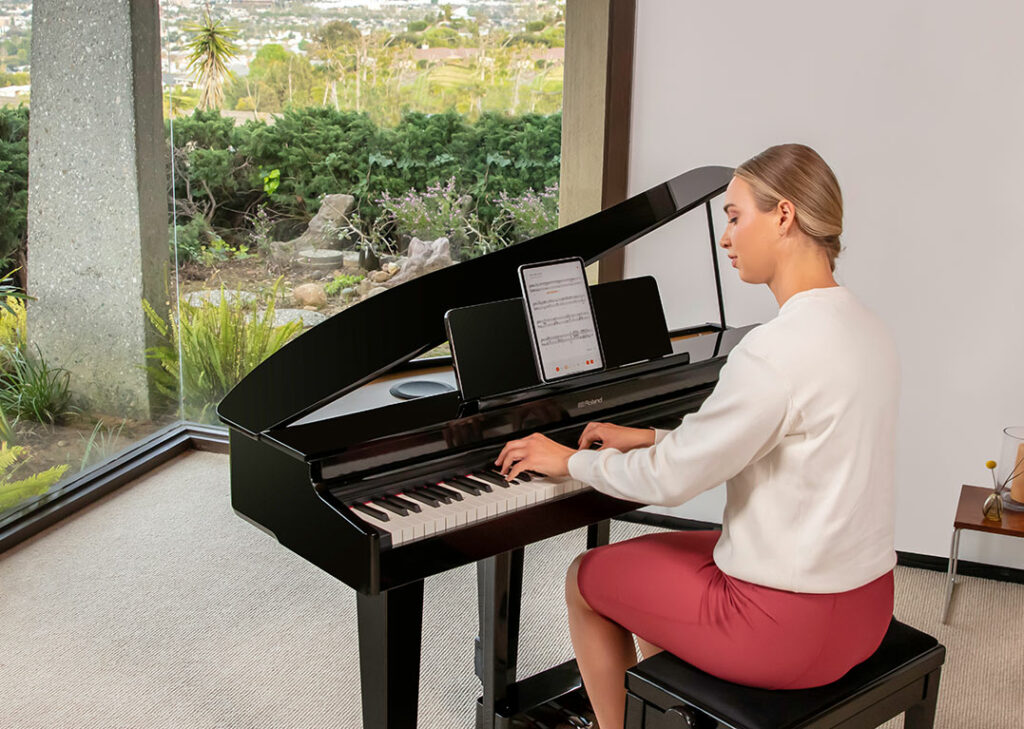
Digital Piano Action & Pedals Explained
Having a good quality piano action is essential if you are to develop a good piano technique.
Let’s start by looking at the feel and response of the keys. Every time you press a key on an acoustic piano, a hammer strikes a string causing the string to vibrate and sound a note. The hammer is connected to the key by a series of levers which gives a natural weight and feeling of resistance each time you press a key.
So how does a digital piano effectively simulate this weight and resistance?
Keyboards and synths use a spring loaded key action where a spring at the back of the key ensures the key returns to the up position. Entry level digital pianos use a similar action but with the addition of a small weight added to each key. This is known as a semi weighted action and is sometimes preferred by some players, particularly those that constantly swap between synths and pianos.
Types of Keyboard
A hammer action keyboard uses actual hammers that rise when a key is struck and fall back under their own weight. This offers a much more realistic feel.
Better still is a Progressive Hammer Action keyboard where the feel of the keys gets slightly heavier as you move down the keyboard. This is because the strings on an acoustic grand piano are shorter and narrow in the treble section and get progressively thicker and longer in the bass section.
The total length of a key is also important. When we say total, we mean including the bit you can’t see. The longer the total length, the further back you can have the pivot point which makes it easier to play and gives more expression when playing the white keys right up in between the black notes. This will be essential as you get more advanced.
Digital piano keys are usually made of plastic but in some cases are made of wood. Some will argue that a wooden key is more realistic but, as long as the weight or mass of the key gives the same resistance as that of an acoustic piano, it shouldn’t matter what it’s made of.
It is important to point out that there is no right or correct touch to simulate as not all acoustic pianos feel the same. For example, a grand piano is usually lighter in touch than an upright piano and even uprights from the same manufacturer can vary, it is what you feel most comfortable playing that is the most important factor.
Pedals
We must not forget the piano pedals. Most pianos will have three pedals, the most important of which is the one on the right, called the damper pedal. When we release a key, the sound ends abruptly which makes it impossible to join two notes situated far apart. That’s where the damper pedal comes in as it allows the notes to sustain or carry on sounding after your fingers release the key, which is why it is often called the sustain pedal.
On some basic digital piano models, the damper (or sustain) pedal is basically either on or off. But on an acoustic piano it is possible to partially engage the sustain pedal so that the dampers touch the strings very slightly. This technique is called half pedalling and gives a pianist greater control of the sustained sound. Some digital pianos can successfully recreate this effect using a technology called Progressive Damper Action.
The outside left pedal softens both the tone and volume of the sound which is why it is known as the soft pedal and the middle pedal is known as the sostenuto pedal which sustains only the notes that you are playing when you press the pedal down. For example, you can play a big bass note, put the middle pedal down, and then doodle some stuff over the top with the bass note sounding throughout.
Digital Piano Keybeds: Differences in Playing Experience
What are the main differences between Roland’s PHA-4, PHA-50, and Hybrid Grand actions?
The key differences among these actions include pivot length, materials, key stabilization, and keytop finishes. The PHA-4 is an all-plastic action with a standard pivot length, the PHA-50 incorporates wood for added durability and realism with a slightly longer pivot, and the Hybrid Grand extends the pivot length even further, mimicking the feel of a grand piano.
PHA-4 Action
The PHA-4 is a little different than the others in that the static resistance on the PHA-4 is actually a little bit higher than the dynamic resistance, and this is definitely pronounced when playing this action right out of the box before it’s been worked in (most actions, but the PHA-4 especially requires a breaking in period.)
But even once the PHA-4 has been broken in, there’s still about a 10-gram weight difference between what it takes to get the key in motion and what it takes to keep it in motion. This difference in weighting creates the perception of a deeper keybed.
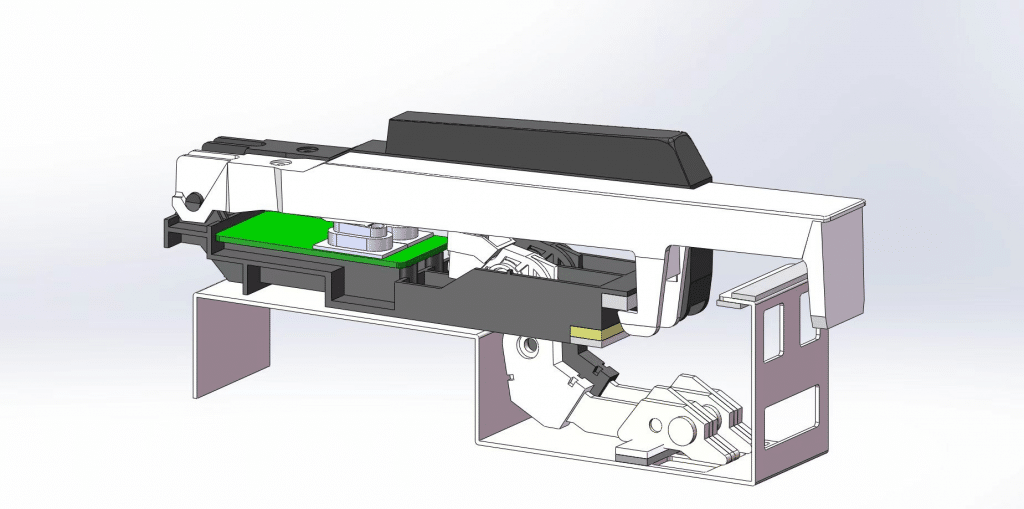
PHA-50 Action
You don’t have this weighting difference on the PHA-50, or the Hybrid Grand action for that matter. It’s actually quite noticeable when you play and also makes the PHA-50 better suited for classical music, as does the extra pivot length which offers greater control.
Secondly, you can actually feel the presence of the stabilizing pin as there is literally no give or lateral motion on the keys.
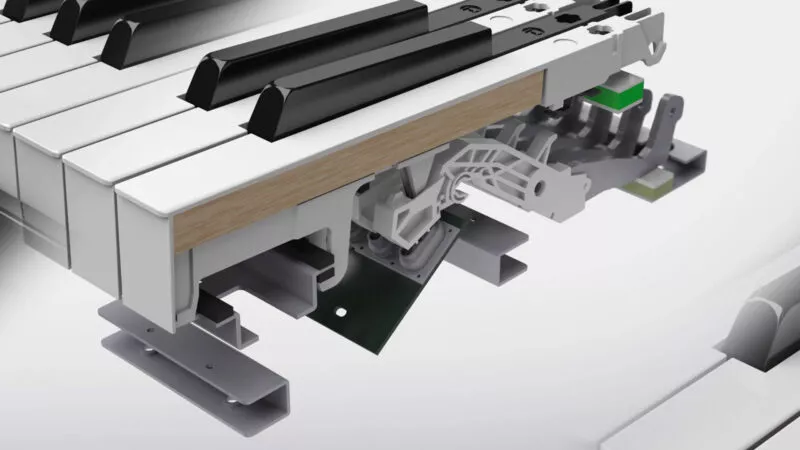
Hybrid Grand Action
Moving to the Hybrid Grand action, and really, you can think of it as a stretched version of the PHA-50. The technology is the same, the only real difference is the longer pivot length that the Hybrid Grand possesses.
The result, as we mentioned above, is an even deeper sense of control, and in the hands of a skilled pianist, the amount of detail this action is able to coax more out of our new PureAcoustic modeling technology sound engine (and our SuperNATURAL piano engine for that matter) is remarkable.
Moving to the Hybrid Grand action, and really, you can think of it as a stretched version of the PHA-50. The technology is the same, the only real difference is the longer pivot length that the Hybrid Grand possesses.
The result, as we mentioned above, is an even deeper sense of control, and in the hands of a skilled pianist, the amount of detail this action is able to coax more out of our new PureAcoustic modeling technology sound engine (and our SuperNATURAL piano engine for that matter) is remarkable.
Differences – PHA-4, PHA-50, Hybrid Grand
What really separates these three keyboard actions and what are the characteristics that you can expect when you’re playing on them?
Pivot Length
What do we mean when we say pivot length? Pivot length is the distance between the front of the key to the point at where the key is hinged, which serves as the fulcrum.
The reason that this is such a huge factor here is that distance determines how much motion there is at the front of the key versus the middle of the key, and thus how much of a change in how the action feels depending on how far out or in on the action you happen to be playing. The longer the pivot length, the greater sense of control afforded to the player.
The PHA-4 has a fairly standard pivot length compared to the average digital piano action, while the PHA-50 gets a little bit longer, before finally getting to the Hybrid Grand which boasts a pivot length that is on par with what you’ll find in some 6 and 7-foot grand pianos.
All three of these actions have escapement and use a triple sensor, so while there shouldn’t be a difference in terms of the MIDI accuracy from a sensor standpoint, the player can manipulate the key with more accuracy with a longer pivot length, so the MIDI information will, in theory, be more accurate as the pivot length gets longer.
Materials & Construction
The PHA-4 hammer action is an all-plastic action, which means that the top key surface, the sides, and the hammer are all plastic. There are obviously some small metal electrical parts, but all of the critical materials here are plastic.
With the PHA-50 and Hybrid Grand action, the sides of the keys are made from wood, and this goes beyond aesthetics as it better simulates the dynamic feel of a grand piano key. It’s also arguable that the presence of wood also makes the action as a whole more durable.
Stabilizing Pin
The third key difference is the stabilizing pin, which is the pin right in middle at the top of all of the keys that sits and serves the same function as the balance rail pin does on a real acoustic piano. This pin allows you to align the key laterally and provides strength to ensure that the keys don’t twist or torque to one side or the other when force isn’t applied directly downward.
So essentially, the centre pin protects the key and adds durability. There is no centre pin present on the PHA-4, whereas there is on the PHA-50 and on the Hybrid Grand.
As a result, the PHA-50 and Hybrid Grand actions are going to be much more durable over a longer period of time.
Keytops – Materials & Finishes
The last key difference between the three actions is the finish on the keytops. The white keys on all three actions use very similar materials. However, the black keys are definitely different.
The black keys on the PHA-4 have a satin finish with a slight texture that feels somewhat like a genuine ebony key. On the PHA-50 and Hybrid Grand, the texture is more visible, to the point that you actually see the wood grain. The result is a more pronounced texture that feels even more realistic.
Piano Reality Overview
Roland have reimagined their entire piano modeling paradigm so they could utilize new high-speed processors and sensors, design a fully digital audio circuit and amplification system, and build cabinets with ideal speaker positioning in mind. Early in the process, they realized that this new modeling platform had to take a holistic approach to piano performance. Each component would not only require individual redesign, but would require integration into the system as a whole. Thus, Roland engineers had to think of the new platform as a single ecosystem – an all-encompassing environment that would include key focus areas like:
The Sound Engine – greater nuance, colour, detail, dynamics and resonance
The Key Action – unmatched sensitivity, speed and control
The Audio Circuit – maintaining a fully digital signal that preserves the highest quality of sound with no degradation
The Amplifier and Speaker System – ideally placed speakers of the correct size and position to create a 3D soundscape
The Pedaling System – greater acoustic control and colour
The Cabinet Design and Interface – streamlined and contemporary user interface inside a cabinet designed for modernity and unparalleled sound
The technical information:
Roland’s Piano Reality is a new approach to digital pianos that aims to replicate the acoustic playing experience, focusing on the sound engine, keyboard, pedals, and audio system as an interconnected ecosystem. It’s designed to immerse the player in a realistic piano performance by replicating the complex interactions and nuances of a concert-grade acoustic grand piano.
Key Components of Piano Reality:
Sound Engine:
Roland’s advanced piano modeling technology uses sophisticated algorithms to recreate the interactive tonal qualities of an acoustic grand piano, going beyond simple sampling.
Keyboard:
The Piano Reality Standard keyboard features progressive hammer action, escapement, Ivory Feel material, and accelerated key sensing, aiming to provide the same touch and feel as a concert-grade acoustic instrument.
Pedals:
Sustain, soft, and sostenuto pedals are included with true weighted feel and detection for traditional half-pedal techniques.
Audio Circuit, Amplifiers, and Speakers:
The audio system is designed to deliver a realistic and immersive sound experience, with different speakers playing different sound elements to create a multi-dimensional sound field.
Holistic Approach:
Roland’s engineers focus on how all these components work together as a fully integrated system to create a truly immersive digital piano experience.
Piano AR:
Roland also offers a Piano Augmented Reality (AR) feature, allowing users to virtually place the piano in their living space to visualize the fit and design.
In essence, Piano Reality is a virtual reality system that aims to create a comprehensive and immersive acoustic piano experience for digital piano players.
This video explains what Roland Piano Reality is: